
Business Phone Line Types ExplainedA Plain Guide to Business Phone Lines and What They Cost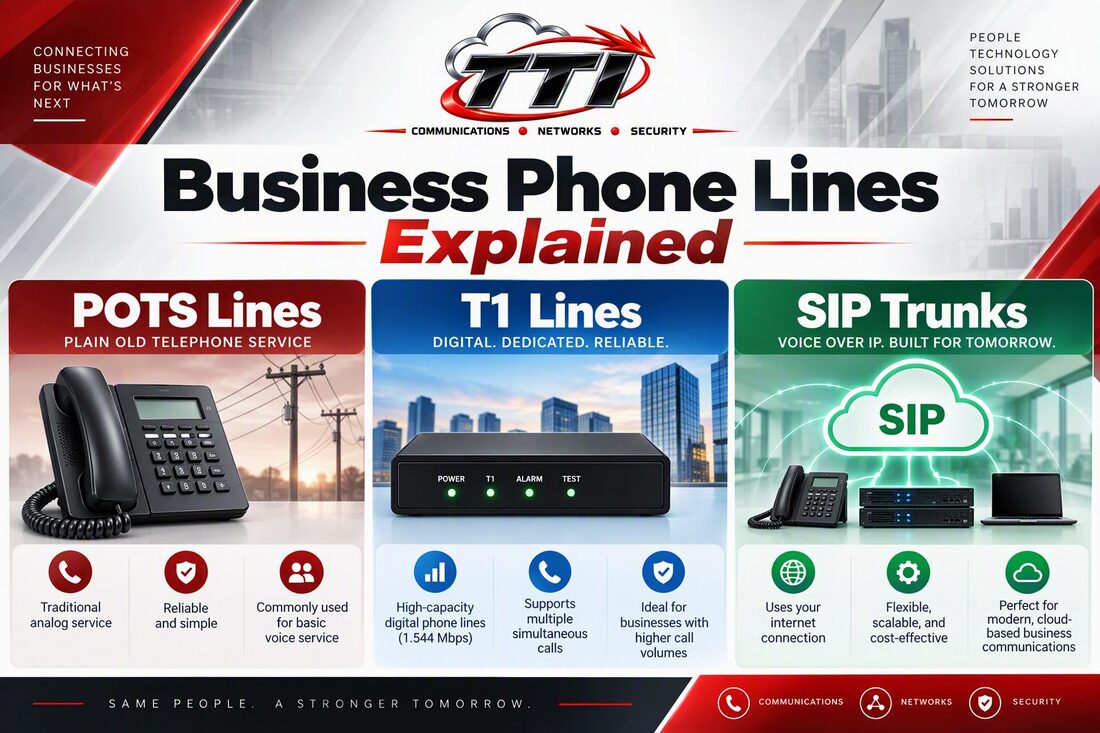
Phone Line TypesPOTS LinesSIP TrunksT1 LinesVoIP (Cloud Phone System)Updated October 2026 Business Phone Line Types ExplainedThe type of phone line your business uses affects call quality, which features you can use, and how easily you can grow. Here is a plain-language look at the four main line types TTI works with across NJ, PA, and NY, and when each one makes sense. POTS Lines (Traditional Copper)POTS stands for "plain old telephone service." These are the traditional copper lines from carriers like Verizon. They are simple and work with almost any phone system, but many carriers are phasing out copper and moving customers to fiber or digital service. Some carrier contracts also renew automatically, so it helps to know your renewal date before it passes. Cable providers such as Comcast also offer business phone lines. Settings like hunt groups and voicemail are sometimes set up incorrectly at installation, and TTI helps customers sort these out with the carrier. T1 LinesA T1 is a dedicated digital circuit that carries multiple phone calls at once. T1s were common for larger offices with on-premise phone systems, but they are expensive to keep and are being replaced by SIP trunks in most businesses. SIP TrunksSIP trunks deliver your phone lines over your internet connection to an on-premise phone system such as Avaya IP Office. You keep your existing system and phones while moving off copper or T1 lines. Plans with unlimited calling in the US and Canada are common for typical business use; high-volume users such as call centers are usually set up differently. Learn more about TTI SIP 500. VoIP and Cloud Phone SystemsWith a cloud phone system, the phone system itself is hosted online instead of in a box in your office. Your team can use desk phones, a mobile app, or a computer, and features such as call recording and texting are available depending on the plan. See TTI's Cloud Phone System. Rough Cost Comparison (2026)Here is how traditional carrier lines compare with TTI SIP trunks. Carrier figures are rough estimates based on what we see on our customers' phone bills, and actual costs depend on your location, contract, call volume, taxes, and fees.
For an exact comparison, TTI can review your current phone bill and show you what your options would look like. Comments are closed.
|